#01_NOVO

Case
Novo Nordisk millions of drug delivery components daily for patients worldwide. Products such as insulin pen injectors and needle assemblies are manufactured at massive scale, where even marginal improvements in production efficiency can translate better patient access to life-saving medications.
The global demand for Novo Nordisk’s products is growing rapidly, driven by increasing prevalence of diabetes and obesity worldwide. To meet this demand, Novo Nordisk must continuously seek ways to expand production capacity. Building new production facilities takes time (years) so a more immediately cost-effective strategy is to reduce unnecessary scrap on existing production lines. Every component incorrectly rejected as defective represents lost material, lost capacity, and a missed opportunity to supply patients in need.
This project explores how Explainable Artificial Intelligence (XAI) can be applied to component inspection on new and legacy production lines at Novo Nordisk, reducing over-rejection rates while fully complying with the strict regulatory requirements governing pharmaceutical manufacturing.
Motivation
Legacy Inspection Systems
Many of Novo Nordisk’s production lines were designed and built before modern machine learning capabilities were available. Component inspection on these lines is performed by handcrafted rule-based systems, where engineers manually define thresholds and logical conditions that determine whether a component passes or fails inspection.
While these systems have continuously been improved, but they suffer from fundamental limitations:
- Rigidity: Rules are static and cannot adapt to natural process variation
- Over-conservatism: To ensure patient safety, rules are often set conservatively, leading to the rejection of components that are within acceptable quality limits
- Maintenance burden: As processes drift over time, rules require constant manual recalibration
- Limited complexity: Rule-based systems struggle to capture complex, multi-dimensional relationships between process parameters and component quality
The consequence of these limitations is systematic over-rejection – good components being classified as defective. This represents a direct capacity loss on affected lines.
Quantifying the Problem
To illustrate the business impact, consider a simplified example:
| Metric | Value |
| Components produced per line per day | 500,000 |
| Current rejection rate | 8% |
| Estimated true defect rate | 5% |
| Over-rejection rate | 3% |
| Daily unnecessary rejections | 15,000 components |
A reduction in the over-rejection rate from 3% to 0.5% would recover approximately 12,500 components per day per line – a significant capacity gain without any capital investment in new equipment. Scaled across multiple lines, this represents a substantial contribution to Novo Nordisk’s target to meet patient needs.
Why Not Simply Apply Standard Machine Learning?
The natural solution to the limitations of rule-based systems might appear to be replacing them with modern machine learning models, such as deep neural networks or gradient boosting classifiers. However, in pharmaceutical production, performance alone is insufficient. Patient safety is the paramount concern, and regulatory frameworks require that every decision in a GxP[1]-regulated process can be fully traced, understood, and justified. A neural network that achieves 99% classification accuracy in production but cannot explain why a component was rejected or accepted does not satisfy these requirements.
This creates a fundamental tension:

Explainable AI is a framework that resolves this tension.
[1] GxP stands for Good x Practice and covers Quality, Safety, Compliance. It is the set of regulations all pharmaceutical companies must follow.
Challenge
Validating a traditional rule-based system is straightforward since rules can be inspected directly. Validating an XAI system requires additional steps to confirm that not only are the predictions correct, but the explanations are meaningful and trustworthy.
Data Collection:
Step 1:
- Design an experiment that collects force data using the supplied setup for 1 assembly variant (1 combination of housing and part). Collect data of both successful and unsuccessful assemblies. Remember to label the data and collect ALL failed assemblies, even unintentional failures.
- Collect data for additional variants by either changing the housing or the part.
XAI
Step 1: Predictive Performance Validation
- The students are expected to compare XAI model performance against a rule-based system on held-out test data from the provided snap assembly.
- Key metrics: Precision, Recall, F1-score, with specific focus on False Negative Rate (missed defects – patient safety critical)
- Establish that the XAI model does not increase the false negative rate vs. the legacy system
Step 2: Explanation Faithfulness
- Verify that SHAP explanations accurately reflect the model’s internal behavior
- Use ablation testing: remove top-ranked features and confirm model performance degrades as expected
Step 3: Consistency Testing
- Verify that similar components receive similar explanations
- Flag inconsistencies for investigation (Outliers, predictions with low confidence etc.)
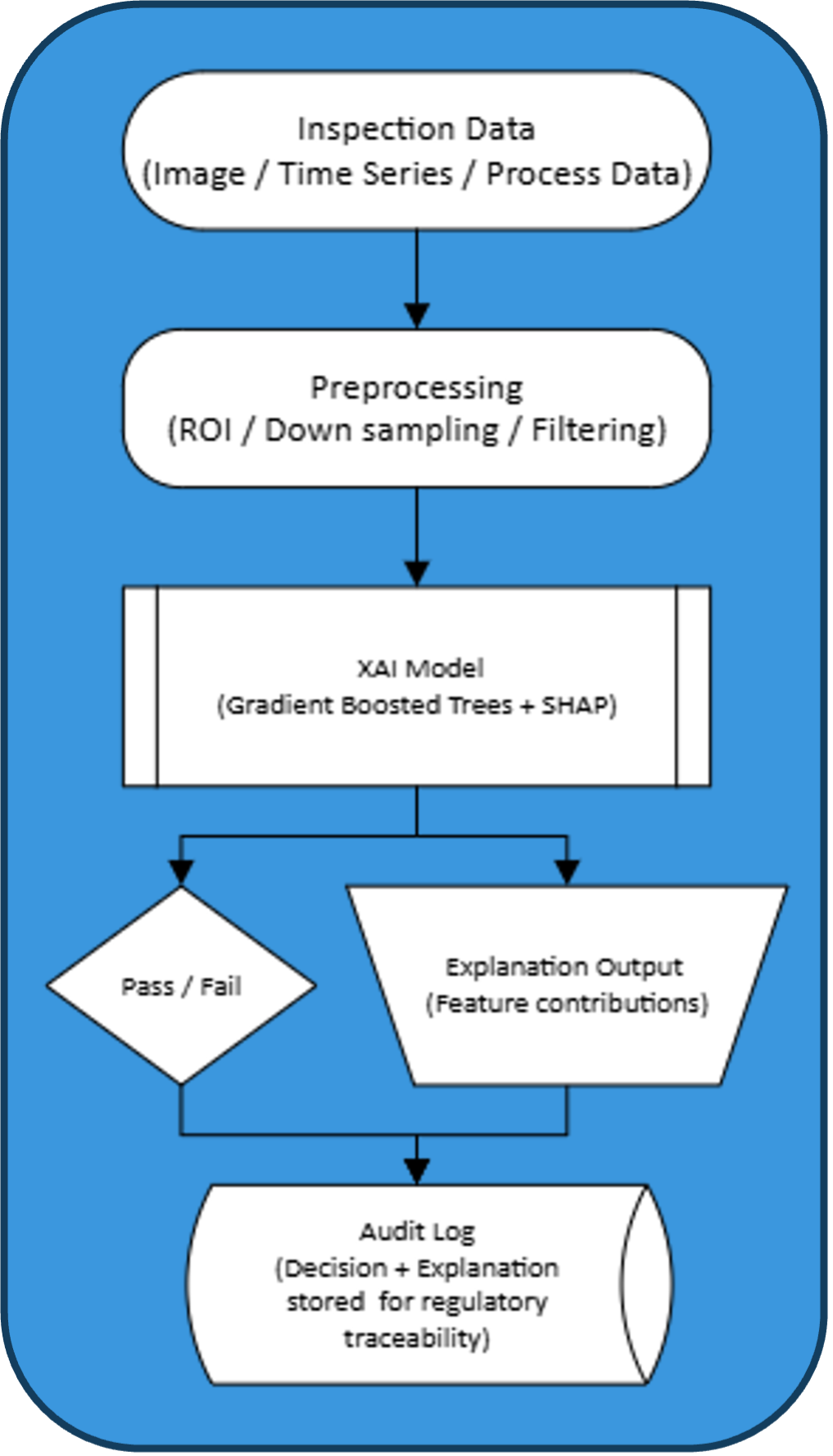
Proposed Pipeline:
Equipment
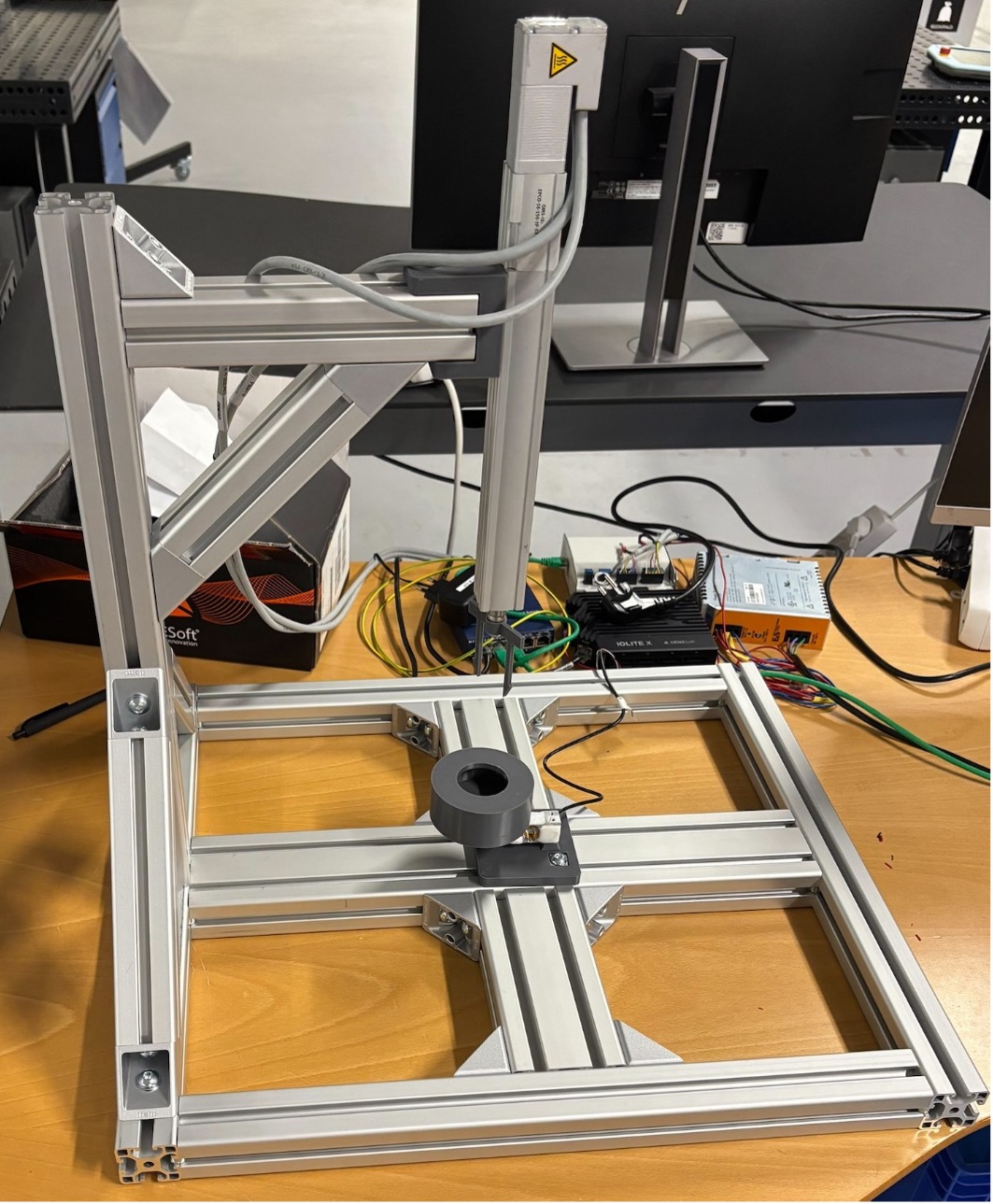
The student will be provided with a set of clips (parts) and housing to generate a dataset of acceptable and unacceptable assembly scenarios. They will be supplied with an assembly station equipped with a Kistler force sensor and a linear actuator. See picture below. They will receive access to a computer with the necessary software to interface with the DEWEsoft platform, and a script to automatically collect and store data. Additionally, they will receive some boiler plate code for preprocessing the signal and aligning signal similar to a real high-volume line.